
Authorities were on their toes in Banaskantha and Patan districts and relocated thousands of people residing in low-lying areas to safer places, they said.
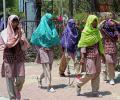
The global body added that national meteorological and hydrological departments in both countries are working closely with health and disaster management agencies to roll out heat health action plans.

The name 'Nargis' means daffodil in Urdu for the cyclone was suggested by Pakistan to the India Meteorological Department, which is a Regional Specialised Meteorological Center recognised by the World Meteorological Organisation, IMD Director B P Yadav told PTI. IMD has the mandate to provide weather advisories to seven countries -- Bangladesh, the Maldives, Myanmar, Oman, Pakistan, Thailand and Sri Lanka besides India.
Torrential rains continued to lash Mumbai and coastal parts of Maharashtra for the second consecutive day on Monday, disrupting normal life in the region.
The southwest monsoon, which has gathered significant pace in the last few days, is expected to cover the entire country in two-three days, the India Meteorological Department said on Friday.

The city's Air Quality Index (AQI) stood at 420 at 8 am on Thursday, compared to 426 at 4 pm on Wednesday. The AQI map prepared by the Central Pollution Control Board showed clusters of red dots (indicating hazardous air quality) spread across the Indo-Gangetic plains.

IMD Director General Dr Mrutyunjay Mohapatra said that 'Yaas' is likely to intensify into a Very Severe Cyclonic Storm by Tuesday evening and Chandbali is likely to witness the maximum damage caused by it.

Operations at the Delhi airport remained normal. However, three flights were returned or diverted to the Delhi airport due to bad weather in Chandigarh, Varanasi and Lucknow on Tuesday night.

A strong 6.8 magnitude earthquake with the epicentre in Afghanistan shook Pakistan, killing at least 12 people and injuring nearly 250 others in both the countries, authorities said on Wednesday.

IMD director general Mrutunjay Mohapatra said that cyclone Asani has already achieved maximum stage of intensification and is gradually getting weakened.

The cyclone is expected to make landfall on Thursday evening as a 'very severe cyclonic storm' with maximum wind speed reaching up to 150 kilometres per hour, the India Meteorological Department (IMD) said.

The poisonous haze has been causing significant problems for people with existing respiratory issues, according to doctors.
The cold wave continued unabated in Jammu and Kashmir where Leh, in Ladakh region, was recorded to be the coldest place in the state, while the night temperature in Srinagar remained below the freezing point for the seventh consecutive night, a meteorological department official said in Srinagar.
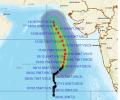
'Very severe cyclonic storm Biparjoy at 2330 hrs IST of 9th June over east-central Arabian Sea near lat 16.0N & long 67.4E. Likely to intensify further & move north-northeastwards during the next 24hrs,' the IMD said in a tweet.

The government declared Monday (Dec 4) a public holiday and urged private companies to encourage 'work from home' option for its employees in Chennai, Tiruvallur, Kancheepuram and Chengalpattu districts.

Tamil Nadu continued to experience monsoon fury, with heavy rains pounding various parts of the state under the influence of a well marked low pressure area over Bay of Bengal, as the death toll from rain-related incidents climbed to 59.

The India meteorological department has issued an orange alert for Mumbai, Thane, Palghar and other coastal districts in Maharashtra, stating it is very likely that 'heavy to very heavy' rainfall will occur in isolated places in this region.

The national capital, parts of which reeled under heatwave conditions for the past few days, had some relief on Wednesday with strong winds and partly cloudy skies witnessed during the day.

The Northern Railways said it has cancelled around 17 trains and diverted around 12 others, while traffic has been suspended at four locations due to waterlogging.

The average temperatures observed pan-India for April was 35.05 degrees, which was the fourth highest in 122 years.

West Bengal and Odisha have evacuated lakhs of people from vulnerable areas to safety as severe cyclonic storm 'Yaas' is nearing the coast and is expected to make landfall near Dhamra Port in Bhadrak district early on Wednesday morning.

The landfall process of the eye of the extremely severe cyclonic storm Tauktae, which hit the Gujarat coast in Saurashtra region between Diu and Una, ended around midnight, the India Meteorological Department (IMD) said.

Some low-lying areas like the Andheri subway were submerged, forcing authorities to divert the traffic through alternate routes, civic officials said.

There were no reports of loss of property or life.

The duo used their mobile phone to establish contact for their rescue, following which an NDRF team was roped in.

The same development would benefit the progress of the north-east monsoon, also known as the 'reverse monsoon'.

The very severe cyclonic storm 'Biparjoy' intensified into an 'extremely severe cyclonic storm' and is likely to cross Saurashtra-Kutch and adjoining Pakistan coasts around the afternoon of June 15 as a 'very severe cyclonic storm (VSCS)', the India Meteorological Department said on Sunday.

Breaking a record of 108 years, monsoon on Sunday hit New Delhi almost a fortnight ahead of the schedule.

vThe longest duration cyclone over the north Indian Ocean had developed over the Bay of Bengal and weakened over the Arabian Sea between November 8-23, 1977 with a life period of 14 days and six hours.

Temperatures remained above 45 degrees Celsius in large parts of Rajasthan, Haryana, Delhi, Chandigarh and Uttar Pradesh, affecting daily life as many chose to remain indoors in the afternoon.

The eastern and northern parts of Delhi witnessed rain and hailstorm, IMD said.

Above-normal heatwave days are predicted in most parts of central, east and northwest India during this period.
Because the ecology of various regions differs, it is silly to club them all under one countrywide average number, says Nitin Sethi.
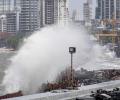
Several major cyclones have hit various parts of India over the last 10 years. Here is a look at the notable among them.
A mild intensity earthquake with a magnitude of 3.2 on the Richter scale stuck the Koyna dam region in Satara on Monday night, officials said.

Mini cloud bursts are marked by intense short spells which may not exceed 10cm in one hour-a classical definition by India Meteorological Department, he noted.
An earthquake of moderate intensity, measuring 5.2 on the Richter scale, jolted India-Bangladesh border in Karimganj on Saturday.

The south-west monsoon on Tuesday started withdrawing from parts of south-west Rajasthan and adjoining Kutch in Gujarat, with at least eight states, including rice bowl states of Uttar Pradesh and Bihar reporting deficient rains. It was for the first time since 2016 that the monsoon started withdrawing in the third week of September. "Southwest monsoon has withdrawn from parts of southwest Rajasthan & adjoining Kutch today, against its normal date of withdrawal from southwest Rajasthan of September 17," the India Meteorological Department (IMD) tweeted.

The January of 1919 recorded 15 degree Celsius and it remains the warmest January so far. "So January 2021 has also become the warmest in 62 years after 1958," the IMD said.

Dense to very dense fog engulfed the Indo-Gangetic plains, including Delhi, for the second morning on the trot on Tuesday, lowering visibility to 50 metres in the city and affecting road traffic and train movement.
 © 2026 Rediff.com - Advertise with us - Disclaimer - Privacy Policy - Sitemap - Feedback - About us - Terms of use - Grievances